Showing posts with label theorizing. Show all posts

Thursday, 29 May 2014

3-D Ant

Simulators often have a dedicated group of fans that often mod, add to and improve the simulator of their liking. Besides a few popular simulators (sims and simcity) I've never really used a simulator. Though lately I have been captivated by Kerbal Space Program. It's a space exploration simulator that let's you build rockets and launch and manoeuvre them.

Source: Fatal1ty.com


Most of the time simulators are perceived as different to games. There's usually no structure to guide a player nor is there an opponent. Still as ever being a game or not is not a dichotomy. KSP is one of those simulators that is beginning to bridge the divide.

One of the last updates for KSP has introduced a career mode. Instead of having ready access to all rocket parts from the start, you have to unlock several parts at a time by collecting research credits during missions. This forces you to think about efficiency and feasibility of your exploration missions. There will probably be a few more parameters added in the future, to make the carreer mode more challenging and realistic.

This career mode probably made it fun for me. Instead of having ready access to parts, I have to push myself while being introduced to space exploration on a step by step basis. Nothing is more frustrating then spending half an hour to get a craft in a lunar orbit, but crashing it during landing...

Simulator games can offer us many benefits as a training ground and often a cheap alternative for the real thing.

So here's a parable on space exploration, borrowed from the anime Space Brothers (宇宙兄弟):

Once there were ants, only able to move forward on a straight path.
These 1-D ants walked on and on, till they met an obstacle.
It was a rock, and all the ants halted their way and panicked.
"How do we get passed it? " they said amongst themselves.

One ant rose up and said, "follow me!".
The ant showed them how to move left around the obstacle.
and at a next rock another ant showed them to move right.
The 2-D ant was born.

Able to move forward, left, right and backwards (left+left, right+right).
They travelled far, they travelled wide.
In the end they hit an obstacle, as far as they could travel left and right.
"How do we get passed it? " they said amongst themselves.

Source: Kenny Meguro
Yet again an and rose up and said, "follow me!".
And they moved up, climbing the wall.
The 3-D ant was born.


How do games expand your world?


Monday, 17 March 2014

Play and games; a closer look

Lately I feel the urge to broaden my personal view of games and the behaviour of play. I came to realise that I probably skipped a few steps by diving deep into the world of the motivation to play games. Games seem to be implicitly linked to so many things like the image of a child having fun, innocence, no serious implications, past-time silliness  and the behaviour of play itself. I'm probably not qualified to paint a picture of games and play that's sound in all the related areas of expertise like biology, neurology and anthropology. But I want to move forward in my understanding of games and will just give it a shot.

The behaviour implicitly linked to games is "play". Games are played, though sometimes we simply say we game*. That there are words created for these phenomena almost makes you forget that the behaviour of play is not exclusive to the human species. There does appear to be a minimal level of intelligence before playful behaviour is displayed. Playful ravens, wolfs, seals, felines are easy to imagine. Still it would be a blast if fish or Cephalopoda were found with playful behaviour. Regardless of the species, playful behaviour does seem to fade as age increases.

Playful behaviour of other beings should not be judged through human morality, else it can seem quite malignent.


Playful behaviour always seems to lack serious implications or a fixed goal. The seal in the previous video was not meant to be eaten, like a clean and efficient kill.


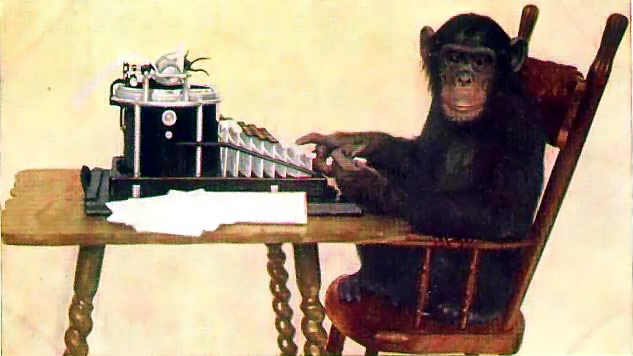
There are probably exceptions but a lot of playful behaviour seems to be embedded in social contact. Playing with others is more fun of course and creating cards to play solitaire seems to be a prerequisite for more intricate solo play. Unless monkeys program their first game.

Source: Wikimedia - New York Zoological Society


* A construct set up to facilitate play might even be the best definition of “game”, because the behaviour of play differs so much it's clearly hard to define universal characteristics of games.